How to Choose a Fire Rebuild Contractor in Altadena After a Total Loss
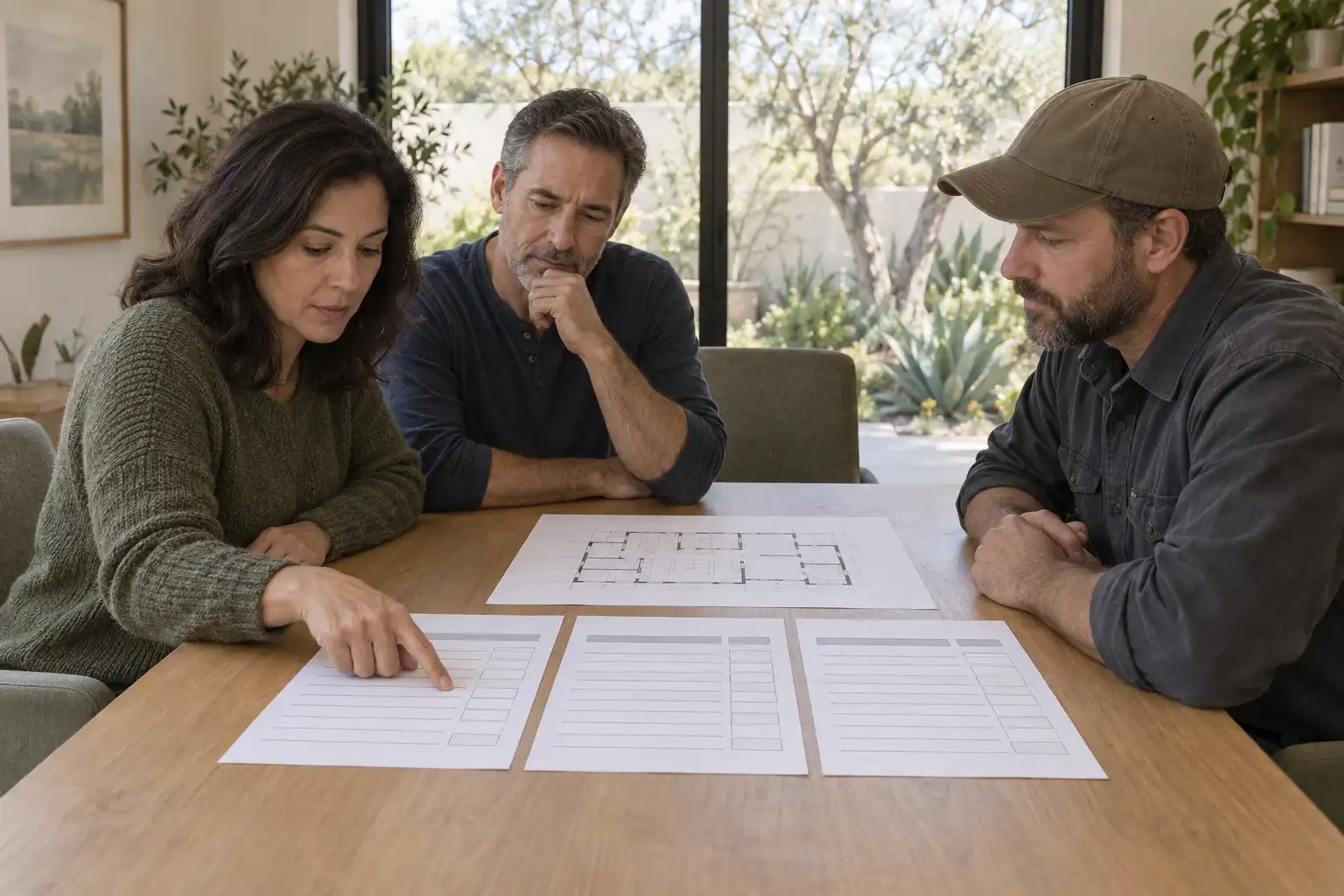
How to Choose a Fire Rebuild Contractor in Altadena After a Total Loss
Choose an Altadena fire rebuild contractor by verifying the license, classification, and insurance through the California Contractors State License Board (CSLB) License Check before anything else. Then collect at least three written bids based on identical plans and scope, ask each contractor to demonstrate — with documents, not promises — how they manage permits, inspections, schedule, and field quality, and confirm that the contract and payment terms follow CSLB's current disaster-rebuild guidance.
That sequence — verify, compare, test accountability, then check the contract — is the framework this guide walks through. Many contractors will tell you they are full service. The question is whether they can show you the artifacts that support it: a sample schedule update, a written change-order form, an inspection log, a payment schedule tied to completed work, and a clear answer about who owns each phase of your rebuild.
This guide is general education for Altadena homeowners navigating a total-loss rebuild. Insurance, legal, engineering, and permit specifics vary by property, policy, and jurisdiction. For project-specific answers, work with your insurer, your building department, and licensed architects, engineers, and contractors.
Step 1: Verify the License, Insurance, and Bond
A license number on a business card, bid, or website does not mean the license is valid. CSLB requires contractors to display their license number on advertisements, bids, and contracts — but the number alone tells you nothing about current status. You need to look it up yourself.
How to run the check
- Go to CSLB's License Check. Search by license number, business name, or contractor name. You can also call CSLB directly.
- Confirm a B – General Building classification. CSLB's Disaster Help Center tells wildfire rebuilders to verify that the contractor holds a B license in good standing. Under California law, a general building contractor is one whose principal business involves structures requiring at least two unrelated building trades.
- Check the license record for workers' compensation and bond information. Workers' compensation insurance is required if a contractor has employees. CSLB does not require commercial general liability insurance, but says a contractor without it should be able to explain how damage to your property would be covered. Ask for a Certificate of Insurance or the carrier and agency name.
- Ask to see the pocket license and photo ID. CSLB advises confirming that the person in front of you matches the license on file.
- Check salesperson registration. If someone other than the license holder is selling the project, that person must be registered with CSLB as a Home Improvement Salesperson. Ask to see the registration card and photo ID.
- Ask how specialty trades are covered. A B-licensed contractor generally must hold the right specialty license or use an appropriately licensed subcontractor for specialty work. Ask which subcontractors carry their own licenses and for which trades.
What to understand about the bond
Licensed contractors must carry a contractor license bond; CSLB's guidance page lists the current amount. CSLB notes that this bond is often not enough to cover multiple complaints or a project worth more than the bond amount, and that it does not assure financial or professional competence. For a total-loss rebuild, you may want to ask about separate performance and payment bonds, which CSLB describes as guaranteeing completion and payment. CSLB states in general terms that these contract bonds typically cost about 1–2 percent of the contract price; that is not a quote for any specific rebuild. Confirm current bond requirements directly with CSLB.
Two warnings from CSLB
- Construction "consultants" need a license too. CSLB's Fast Facts for disaster rebuilding warns that anyone who bids, contracts, or oversees the project and workers must be CSLB-licensed.
- Disaster recovery is not an ideal time to act as your own owner-builder. CSLB says that as an owner-builder, you may be responsible for damages and for employment and tax obligations.
What to ask to see: The CSLB License Check printout you pulled yourself, a current Certificate of Insurance, and the contractor's pocket license with matching photo ID.
Step 2: Test for Comparable Total-Loss and Local Experience
A contractor who has completed kitchen remodels, additions, or even partial fire repairs is not necessarily prepared for a ground-up total-loss rebuild. A total loss often means starting from a cleared lot and can involve a new foundation, full framing, all mechanical systems, all inspections, full finishes, and final approval. The scope is fundamentally different from a repair.
Questions to ask about experience
- How many total-loss or ground-up residential rebuilds have you completed, start to finish?
- Have you rebuilt homes in Altadena or in unincorporated Los Angeles County? If so, which permitting authority did you work with, and how did inspections go?
- Can you provide references from homeowners who went through a comparable total-loss rebuild — not a renovation or a partial repair?
- Are you familiar with the wildfire-resistant construction requirements that apply in this area? (You do not need them to recite code sections. You need them to explain how those requirements affect framing, materials, and inspections on your project.)
- What is your current backlog? How many projects are you managing right now, and how would you staff mine?
How to check references
When you call references, ask specific questions:
- Was the project a total loss or a partial repair?
- Did the contractor handle permits and inspections, or did the homeowner have to manage those?
- How did the contractor communicate schedule changes, unexpected issues, or cost adjustments?
- Were there change orders? How were they handled?
- Did the project finish on the schedule that was communicated, or were there significant delays? How were those explained?
- Would you hire this contractor again for a similar project?
What to ask to see: A list of completed total-loss rebuild references with permission to contact them, and photos or documentation from a comparable project.
Step 3: Compare Proposals on Scope, Not Just Price
CSLB recommends collecting at least three written bids based on identical plans, specifications, and scope. This matters because if each contractor is bidding on a different interpretation of your project, the numbers are not comparable.
CSLB also warns against automatically taking the lowest bid. A bid substantially lower than the others may omit work that the other contractors included. The low number may look like a deal, but it can signal missing scope or tight allowances that turn into change orders later. A proposal can also be incomplete simply because the plans are incomplete, so ask questions before drawing conclusions.
Why bids look so different
Even when every proposal says "full service," the details often vary in ways that change the real cost and risk:
- Inclusions and exclusions. One proposal might include grading, utility connections, and landscaping. Another might exclude all three. If the scope descriptions are vague, you cannot compare them.
- Allowances. An allowance is a placeholder dollar amount for an item you have not yet selected — like flooring, fixtures, or cabinetry. If one contractor uses tight allowances and another uses generous ones, the bid totals will look different even though the real cost might be the same.
- Contingency handling. Ask each contractor whether the bid includes a contingency line and what happens when unforeseen conditions arise.
- Change-order process. Ask what triggers a change order, how it is priced, who approves it, and what happens to the schedule.
Proposal comparison worksheet
Use this table to compare proposals side by side. Fill in one column per contractor. The "Why this matters" column explains what you are looking for.
| Category | Contractor A | Contractor B | Contractor C | Why this matters |
|---|---|---|---|---|
| Scope inclusions | What work is explicitly included? Grading, foundation, framing, MEP rough-in, insulation, drywall, finishes, landscaping, utility connections? | |||
| Scope exclusions | What is explicitly excluded? Excluded items become your responsibility or a future change order. | |||
| Allowances | Which items use placeholder amounts? Are the allowances realistic for your selections, or will overages add cost? | |||
| Contingency handling | Is there a contingency line? What triggers it? How are unforeseen conditions handled? | |||
| Change-order process | How are changes priced and approved? Are change orders written and signed before work begins? | |||
| Payment milestones | Are payments tied to completed work? Does the schedule follow CSLB's disaster-contract guidance? | |||
| Named subcontractors and suppliers | Who is actually doing the work? Are subcontractors named? Are they licensed for their specialty? | |||
| Permit and inspection responsibilities | Who pulls permits? Who schedules and attends inspections? Who is responsible for corrections? | |||
| Schedule format and updates | Is there a written project schedule? How often is it updated? How are delays communicated? | |||
| Closeout deliverables | What do you receive at the end? Final inspection sign-off, warranty documents, lien releases, as-built drawings, equipment manuals? | |||
| Warranty terms | What does the contractor warrant? What is the warranty period? What is excluded? |
What to ask to see: A detailed written proposal with line items, named exclusions, listed allowances, and a payment schedule — not a one-page summary.
Step 4: Test Accountability Before You Sign
This is a step that is easy to skip. A contractor says "we handle everything." The question is: how? And can they show you?
Every claim a contractor makes — "we manage permits," "we coordinate inspections," "we control quality" — should be matched to an artifact: a document, a process, or a record that the homeowner can see. If the contractor cannot show you how they track and communicate these responsibilities before you sign, the claim is an assurance, not a system.
Accountability map
Use this table to ask each contractor who owns each critical task and what documentation they can show you.
| Task | Who owns it in writing? | Artifact to request |
|---|---|---|
| Permit applications and approvals | Named in the contract? | Sample permit application or a description of their permit process for your jurisdiction |
| Inspection scheduling and attendance | Named in the contract? | Sample inspection log or checklist from a prior project |
| Insurance documentation coordination | Named in the contract? | Description of what rebuild documentation they provide that supports insurance requirements |
| Subcontractor coordination | Named in the contract? | List of subcontractors with license numbers and scope assignments |
| Schedule management | Named in the contract? | Sample project schedule and a description of how updates are shared with the homeowner |
| Field quality control before work is covered | Named in the contract? | Sample jobsite photos, pre-inspection checklists, or quality-verification documentation |
| Closeout and final handoff | Named in the contract? | List of closeout deliverables: final inspection, lien releases, warranties, equipment manuals, as-built documents |
A contractor who operates a documented, tracked process should be able to show you these things. If a contractor cannot, ask how they track and communicate those responsibilities instead.
What to ask to see: Any sample documentation from a completed project — a schedule update, a set of jobsite photos, an inspection log — that demonstrates how the contractor actually manages the work.
Check the Contract and Payment Terms
CSLB's Disaster Help Center provides specific guidance for wildfire rebuilds that directly affects your contract. As of this writing, CSLB's disaster guidance says:
- Rebuilding after a wildfire or declared disaster is treated as a home improvement project under California law.
- Contractors must use a fixed-price contract. Time-and-materials and cost-plus contracts are not allowed for disaster-related home improvement work.
- The down payment cannot exceed $1,000 or 10 percent of the contract price, whichever is less. For any contract above $10,000, that means the cap is $1,000.
- All other payments must be listed in the contract and tied to the actual value of work completed or materials delivered.
- Never sign a contract or change order that requires a progress payment larger than the work completed.
- CSLB says that if a contractor cannot meet these rules, seek other bids.
CSLB's consumer guide to home improvement contracts notes a down-payment exception for licensees who furnish certain bonds, and the state's home improvement contract rules may contain related bond-based exceptions to the payment limits. Ask CSLB whether any exception could apply to a contractor's proposed terms, and have a licensed attorney review your specific contract. Rules and guidance can change, so confirm current requirements with CSLB. For more on how contract types divide cost risk, see our guide to fixed-price vs. cost-plus contracts for your Altadena rebuild.
What the contract should include
CSLB's Fast Facts for disaster rebuilding (revised August 2020; check CSLB for any newer edition) advises including these items in the written contract:
- Project start and completion dates
- A payment schedule — never pay in cash
- Detailed material descriptions
- Names of all subcontractors and suppliers
- A requirement that all change orders be in writing, signed by both parties
Lien releases
CSLB advises getting lien releases throughout the project, signed by the contractor and subcontractors once work is completed and paid for. A lien release is a document confirming that the party has been paid and will not place a lien — a legal claim — against your property for that portion of work. Ask before you sign: what is your lien-release practice, and will you provide releases before each progress payment?
Protect your insurance funds
CSLB suggests keeping insurance funds in a safe place, such as a construction escrow account, because your contractor is not a government-insured financial institution. Discuss this option with your insurer and your attorney. If a mortgage lender holds part of your insurance proceeds, it also helps to understand how rebuild draws work in Altadena.
What to ask to see: A draft contract (not just a proposal) with a fixed price, a payment schedule tied to completed work, named subcontractors, a written change-order requirement, and the contractor's lien-release practice — ready for you to compare against CSLB's current guidance before you sign.
Red Flags to Watch For
Rebuild decisions are often made under time pressure, which is when mistakes are easiest to make. These warning signs — along with those in our guide to hiring a contractor for your Altadena fire rebuild — should prompt you to slow down and verify:
- Pressure to sign immediately. A reputable contractor should be willing to give you time to compare bids, check references, and review the contract. Urgency language — "this price is only good today" or "we're filling up fast" — is a reason to pause, not rush.
- A large upfront payment request. CSLB's disaster guidance caps down payments. If a contractor asks for a large deposit that exceeds the limits described above, ask why and confirm with CSLB.
- Vague scope or a one-page proposal. A total-loss rebuild is a complex project. If the proposal does not specify inclusions, exclusions, allowances, subcontractors, and a payment schedule, it is hard to hold anyone accountable to it.
- No verifiable license. If the license number does not come back as active and in good standing on CSLB's License Check, stop. Do not rely on a business card or a verbal claim.
- Resistance to providing references. A contractor who has completed comparable total-loss rebuilds should be willing to connect you with previous clients.
- No written change-order process. Verbal agreements about changes can lead to disputes. Everything should be written, priced, and signed before work begins.
- Unwillingness to discuss lien releases. If a contractor avoids the topic of lien releases, treat that as a concern. Lien releases can help protect you from claims by unpaid subcontractors or suppliers.
- Unverifiable insurance. If the contractor cannot provide a Certificate of Insurance or explain how damage to your property would be covered, treat that as a serious gap.
Design-Build Versus Separate Architect and Builder
After a total loss, you will need both design and construction. The question is whether one integrated team handles both or whether you hire a licensed architect separately and then bid the construction.
- Design-build means a single team manages design coordination and construction under one contract. This can simplify communication and scheduling, because the builder is involved from the design phase and can flag construction issues before plans are finalized.
- Separate architect and builder means you hire a licensed architect to produce the plans, then bid the construction to licensed general contractors. This can give you more independent oversight of the design, but requires you to coordinate between two separate teams.
The right choice depends on your project, your preferences, and how much coordination you want to manage yourself. Discuss the tradeoffs with a licensed architect or engineer who understands your property and your goals. If you are rebuilding to the same footprint and floor plan — sometimes called a like-for-like rebuild — the design requirements may be different from a full redesign. Your building department and a licensed design professional can help you understand which path applies to your property.
Confirm Your Permitting Authority
Altadena is generally an unincorporated area of Los Angeles County. That typically means your rebuild permits go through LA County, not the City of Pasadena or the City of Los Angeles — but the permitting authority depends on your specific parcel. Do not assume. Confirm your jurisdiction with your building department.
Use this as a selection test: ask each contractor which agency handles permits for your property and what wildfire-resistant construction requirements they expect to follow. A contractor familiar with your jurisdiction should be able to answer clearly and specifically. If they cannot, ask follow-up questions about their local experience.
For official permit and recovery information, check the LA County recovery site and contact the building department directly for your parcel.
Closeout: What You Should Receive When the Project Is Done
The end of a rebuild is not just moving in. Your contract should spell out what the contractor delivers at closeout:
- Final inspection approval from the building department, which is the jurisdiction's sign-off on the completed work under the approved plans and applicable codes.
- Final and unconditional lien releases from the contractor, all subcontractors, and suppliers.
- Warranty documents — both the contractor's workmanship warranty and manufacturer warranties for installed equipment and materials.
- Equipment manuals and maintenance instructions for mechanical, electrical, and plumbing systems.
- As-built documentation if changes were made during construction.
- An owner orientation — a walkthrough where the contractor explains systems, controls, and maintenance.
CSLB suggests being present when building inspectors are on site to hear any corrections firsthand.
A Note on Insurance Documentation
Your contractor should help organize the rebuild documentation that your insurer may need — progress photos, inspection records, material receipts, and change-order logs. However, insurance coverage questions, claim strategy, and reimbursement decisions belong with your insurer and your public adjuster or attorney, not your contractor. Keep those conversations separate.
Frequently Asked Questions
How much does local Altadena experience matter when choosing a rebuild contractor?
It can matter because permitting, inspections, and wildfire-resistant construction requirements vary by jurisdiction. A contractor who has rebuilt in unincorporated Los Angeles County may be more familiar with the specific process, the building department's expectations, and the inspection sequence than one who has never worked in the area. It is not the only factor, but it is worth testing — start by asking for local references.
Who manages permits, inspections, and field quality on a fire rebuild?
That depends entirely on your contract. Many full-service rebuild contracts assign permits, inspection scheduling, and field quality to the general contractor, but "manages" can mean different things. Ask for specifics: who schedules each inspection, who is present for it, who documents the results, and who is responsible for corrections. If those answers are not in writing, they are not commitments.
Is it normal for a contractor to ask for a large deposit on a fire rebuild?
Generally not under CSLB's disaster guidance. As of this writing, CSLB says the down payment cannot exceed $1,000 or 10 percent of the contract price, whichever is less. Each subsequent payment should correspond to work that has actually been completed or materials that have been delivered to the site — not to future work. A contractor asking for a significantly larger deposit should be asked to explain why, and you should verify the current rules on the CSLB Disaster Help Center. Note that a bond exception may apply — confirm with CSLB and a licensed attorney.
What should I do if a contractor's bid is much lower than the others?
CSLB advises caution. A bid substantially lower than comparable proposals may omit work, use tighter allowances, or exclude items the other contractors included. Before assuming it is a better deal, compare the scope, exclusions, and allowances line by line using the worksheet above. Ask the low bidder specifically what is excluded and what is covered by allowances.
Should I hire a design-build firm or a separate architect and contractor?
Both approaches can work. Design-build can simplify coordination and reduce the gap between what is designed and what is buildable. Separate teams can offer more independent design oversight. The right choice depends on the complexity of your project, whether you are rebuilding to the same plan or redesigning, and how much coordination you want to manage. A licensed architect or engineer can help you evaluate which approach fits your property. For a fuller comparison, see our guide to design-build vs. architect-then-bid for an Altadena fire rebuild.
Apply This Checklist to Any Contractor — Including Us
This guide was designed to work for any contractor you are evaluating. We encourage you to apply every step — the license verification, the experience questions, the proposal comparison, the accountability map, and the contract review — to 1st Choice Design & Development as well.
Our approach to fire damage reconstruction is built around the kind of accountability this checklist tests for: tracked and documented phases, inspection readiness, schedule updates, subcontractor coordination, field quality control before work gets covered, and clear communication throughout the rebuild. We believe the right contractor should be able to show you how the process works, not just tell you.
Schedule a rebuild consultation to discuss your property, your rebuild goals, and how our process holds up against the questions in this guide.
Questions about your rebuild?
We rebuild fire-damaged homes across Altadena and Pacific Palisades, and we are happy to talk through your situation.
Talk to us