How to Compare Two Fire Rebuild Contractor Proposals Before You Sign
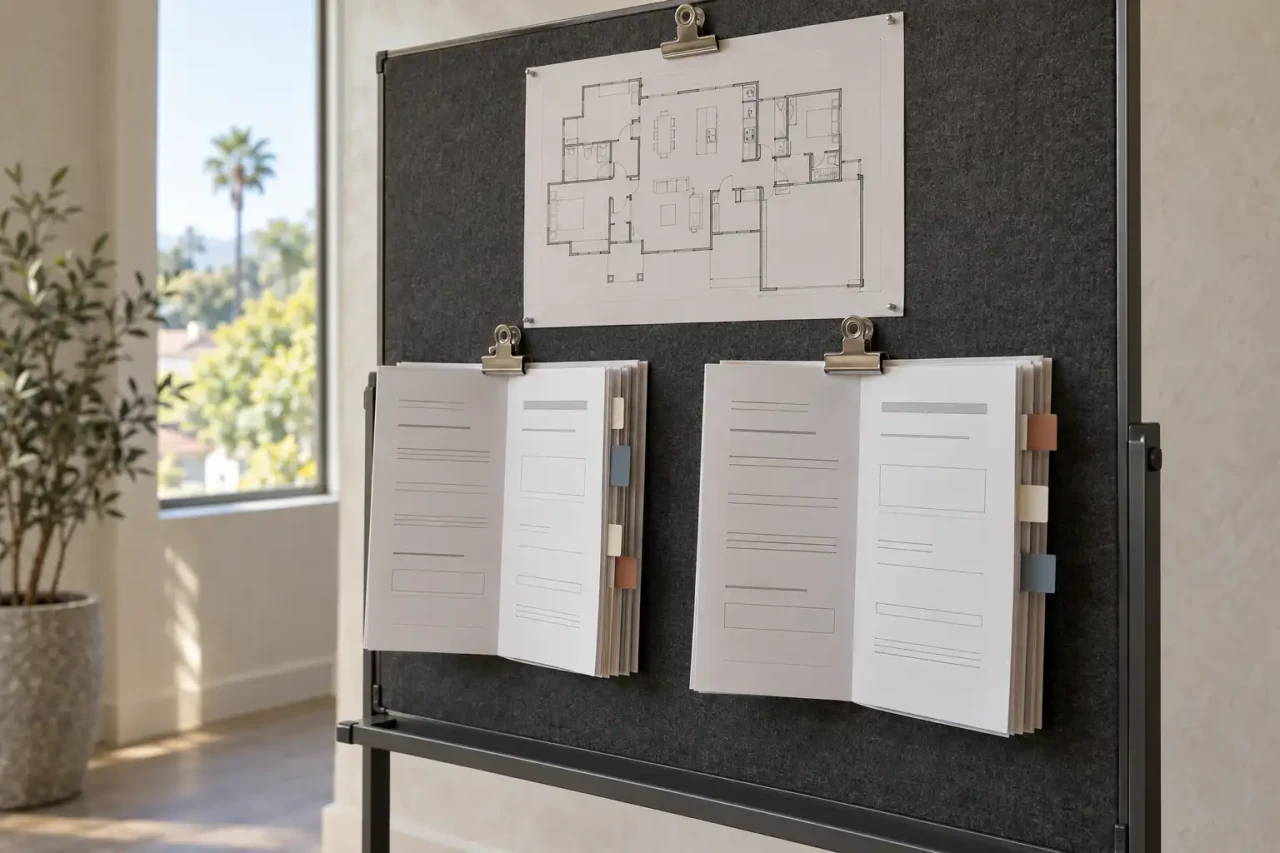
To compare two fire rebuild proposals fairly, confirm that both proposals price the same work before comparing totals. A lower number on one proposal does not mean a lower final cost if the scope, exclusions, allowances, or contract terms differ. The California Contractors State License Board (CSLB) advises homeowners to compare bids on identical plans, specifications, and scope of work, and warns that a bid substantially lower than others probably means a mistake or omitted work (CSLB – Finding the Right Contractor).
This guide gives you a four-step method, a set of comparison worksheets, and a list of identical questions to send both contractors so you can make a confident, informed decision about your wildfire rebuild in Altadena or Pacific Palisades. The four-step method is a framework built from CSLB guidance. It is not an industry standard or new research, and your own insurer, building department, and licensed professionals can answer project-specific questions.
A note on scope: This article focuses on total-loss or major wildfire reconstruction, the kind of project that involves structural framing, foundation, MEP systems, permits, inspections, and a full rebuild from the ground up. If your home sustained partial damage and the question is whether to clean, repair, or replace specific components, the comparison process is different. The method below assumes both proposals are for a substantial reconstruction.
The Four-Step Comparison Method
Most homeowners start by comparing the bottom-line price on each proposal. That is the last step, not the first. Proposal comparisons can break down before price is even meaningful because the two documents are not actually pricing the same project.
Work through these four steps in order:
- Gate: Check that each proposal meets the disaster-contract rules CSLB has stated and that the contractor is verifiable.
- Normalize: Confirm both proposals are based on the same plans, specifications, and scope, and tag every line item as Included, Excluded, Allowance, or Unclear.
- Compare accountability: Compare how each contractor documents work, coordinates permits and inspections, manages subcontractors, communicates with you, and handles change orders.
- Weigh: Compare the normalized price alongside the non-price factors, using your own priorities.
If a proposal fails at the gate step, the price comparison is premature. If the two proposals cover different scope at the normalize step, the totals are not comparable until the gap is resolved. A proposal can be incomparable, not just more or less expensive.
Step 1: The Comparability Gate
Before comparing what each contractor is offering, confirm that both proposals meet the basic requirements that California's licensing board has stated for disaster rebuilds. This is a screening step, not a scoring step. A proposal either passes each row or raises a question you need answered before moving forward.
Why disaster rebuilds have specific contract rules
According to CSLB's Disaster Help Center, rebuilding a home after a declared disaster such as the 2025 Los Angeles wildfires is treated as a home improvement project under the law, not new construction. Home improvement contract and payment rules apply (CSLB Disaster Help Center). CSLB's stated position affects what kind of contract your contractor should use, how much they can collect up front, and how payment milestones must work. CSLB guidance can be updated, so confirm the current rules with CSLB before you sign.
Comparability gate checklist
| Gate item | What CSLB says | What to check on each proposal |
|---|---|---|
| License status | A license number on paper does not prove the license is valid. Verify at CSLB License Check or call (800) 321-CSLB (2752). The person you meet should match the license holder. | Is the license number on the proposal? Have you verified it is active and in good standing? Does the license classification match the work? |
| Workers' compensation insurance | A contractor with employees must carry workers' comp. If the contractor is uninsured and a worker is injured, you could be financially liable. | Does CSLB's license history page show current workers' comp coverage? Has the contractor provided proof? |
| General liability insurance | Not legally required, but covers damage to your property during construction. CSLB says a contractor without it should explain how damage would be covered. | Have you requested a Certificate of Insurance? Confirm the coverage type and limits with your own insurer. |
| Contract type | CSLB states that disaster-related home improvement work must use a fixed-price contract, and that time-and-materials and cost-plus contracts are not allowed for this category of work. Confirm with CSLB whether this applies to your specific project and contract before you sign. | Is each proposal a fixed-price contract? If not, ask the contractor to explain and verify with CSLB. |
| Down payment | CSLB states the down payment limit is $1,000 or 10% of the contract price, whichever is less, and that no exception exists for special-order materials. CSLB notes a narrow exception for contractors carrying a Blanket Performance and Payment Bond on file with CSLB; verify with CSLB directly if a proposal requests more than the standard limit. | What down payment does each proposal require? Does it exceed the CSLB-stated limit? |
| Progress payments | Must be clearly listed in the contract and tied to the value of completed work or delivered materials. Never sign a contract or change order requiring a progress payment larger than the value of the work completed. | Does each proposal include a written payment schedule? Are payments tied to completed work? |
| Change-order process | Changes to price or scope must be in a written change order signed by both parties before the change is made. | Does each proposal describe how change orders are handled? Is the process written, signed, and before-the-fact? |
| Permit responsibility | The contract should state who pulls the permits. Building permits are issued through the local building department, and work done without them can result in fines or required demolition. | Does each proposal state who is responsible for permits? Is it the contractor or the homeowner? |
| Written contract elements | California law requires a written home improvement contract for projects over $500. Required elements include a payment schedule, identification of who pulls permits, a completion date, detailed descriptions of materials, cleanup and debris terms, and any written warranty. | Does each proposal include or reference all of these elements? |
| Mechanics lien warning | Contractors must provide a Mechanics Lien Warning. Subcontractors or suppliers who are not paid can record liens against your property even after you have paid the general contractor in full. CSLB suggests requesting lien releases from subcontractors and suppliers as work is completed. | Does each proposal address lien protection? Will the contractor provide lien releases at each payment? |
| Cancellation rights | CSLB documents describe cancellation rights, but the stated periods differ between general guidance and disaster-specific guidance. Ask your contractor and CSLB what cancellation rights apply to your contract. | Does the contract describe your cancellation rights? Verify the applicable period with CSLB. |
Sources: CSLB – Finding the Right Contractor; CSLB Disaster Help Center; CSLB – Home Improvement Contracts; CSLB – Terms of Agreement Consumer Guide.
If either proposal fails multiple gate items, that does not necessarily disqualify the contractor, but it means you need written answers before moving to scope and price. A proposal that looks less expensive but does not meet these requirements may cost you more later in disputes, liens, or unpermitted work. For a closer look at the individual clauses, see this guide to what should be included in a fire rebuild contract.
Step 2: Normalize the Scope
Two proposals with different totals may be pricing different projects. Before comparing any dollar figure, lay both proposals out on an identical grid and mark every line.
How to tag each line item
Use four tags for every scope category in both proposals:
- Included: The work is part of the contract price with specific materials, quantities, or specifications described.
- Excluded: The work is explicitly left out. You will need to hire someone else or add it later.
- Allowance: A dollar amount is set aside, but the final cost depends on what you choose. Ask what happens if the allowance is exceeded: does the contractor absorb the difference, or do you pay the overage as a change order?
- Unclear: The proposal does not mention this category, or mentions it without enough detail to know what is covered.
Scope normalization grid
Fill in this grid for both proposals. Where a cell is tagged Allowance, write the dollar amount and the overage process. Where a cell is tagged Unclear, that becomes a written question to the contractor before you sign.
| Scope category | Proposal A: status and notes | Proposal B: status and notes |
|---|---|---|
| Plans and revision date referenced | ||
| Total square footage | ||
| Site work: grading, debris removal, erosion control | ||
| Foundation: type, engineering, soil testing | ||
| Structural framing and sheathing | ||
| Roofing | ||
| Waterproofing and drainage | ||
| Windows and exterior doors | ||
| Rough MEP (mechanical, electrical, plumbing) | ||
| Insulation and air sealing | ||
| Interior finishes: drywall, flooring, trim, paint | ||
| Kitchen: cabinets, countertops, appliances | ||
| Bathrooms: fixtures, tile, vanities | ||
| Finish electrical: fixtures, panels, low voltage | ||
| Finish plumbing: fixtures, water heater | ||
| HVAC: system type, ductwork, controls | ||
| Exterior finishes: siding, stucco, hardscape | ||
| Landscaping | ||
| Design and engineering fees | ||
| Permits and fees | ||
| Utility connections and meter sets | ||
| Title 24 energy compliance documentation | ||
| Final cleanup and owner handoff |
For example, if Proposal A includes landscaping and Proposal B excludes it, the totals are not comparable until you price that work separately and add it to Proposal B's number. Likewise, if both proposals use allowances for kitchen cabinets but one sets $15,000 and the other sets $25,000 (hypothetical figures for illustration), the gap in those allowances shifts the real comparison.
The goal is not to pick the proposal with more "Included" tags. The goal is to see clearly what each total actually covers, so you can compare them on equal footing.
Key terms in plain English
- Allowance: A placeholder dollar amount for a category where you have not made final selections yet, such as countertops or lighting fixtures. It is not a cap on what you can spend; it is an estimate. If your choices cost more than the allowance, the difference typically becomes an additional cost, often through a change order, but your contract controls how overages are handled.
- Exclusion: Work that is specifically left out of the contract price. You are responsible for arranging and paying for it separately.
- Change order: A written, signed modification to the contract that changes the scope, price, or schedule. CSLB says it must be signed by both parties before the change is made.
- MEP: Mechanical, electrical, and plumbing. These are the systems inside your walls and under your floors: HVAC ductwork, wiring, pipes, gas lines, and related components.
- Title 24: California's building standards code, which includes energy-efficiency requirements for things like insulation, windows, lighting, and HVAC efficiency. Which version and which requirements apply to your rebuild is a question for your architect or engineer, your contractor, and the local building department that issues your permit.
Step 3: Compare Accountability
Two proposals can match on scope and price and still represent very different experiences during construction. This step compares how each contractor manages the work, communicates with you, and prepares for the milestones that protect your investment.
This is a dimension that is easy to overlook in proposal comparisons. A rebuild is not a one-day transaction. It involves coordinated work across multiple trades, inspections, material deliveries, weather, and decisions. The contractor's process for managing all of that affects how the project progresses and whether problems are caught before they are buried inside walls. To see what the building department's side of that process typically looks like, read about what inspections happen during a ground-up fire reconstruction project in California.
Accountability questions to ask both contractors
Send these questions in writing so you can compare the answers side by side:
| Accountability area | Question to ask | Why it matters |
|---|---|---|
| Day-to-day contact | Who is my primary point of contact during construction? Is that person on site regularly, or managing remotely? | You need to know who to call when you have a question and whether that person sees the work firsthand. |
| Progress documentation | What documentation do you provide during construction? How often? Will I receive photos, written updates, or access to a project log? | Documentation can help protect you if there is a dispute, an insurance question, or a concern about work that is now hidden behind walls. |
| Inspection coordination | Who schedules inspections with the building department? How do you prepare for each inspection? What happens if an inspection does not pass? | Failed inspections can cause delays and rework. A contractor who prepares for inspections before calling them in may help reduce that risk. |
| Quality checks before cover-up | How do you verify the quality of framing, rough MEP, waterproofing, and insulation before those elements are covered by drywall? | Once framing is closed in, the work behind your walls is invisible. Quality problems discovered later are often more expensive to fix. |
| Subcontractor management | Which trades do you self-perform and which do you subcontract? How do you select, schedule, and supervise subcontractors? | Most rebuilds involve multiple specialty trades. How those trades are coordinated can affect quality, schedule, and your exposure to mechanics liens. |
| Schedule ownership | Will I receive a written project schedule? How often is it updated? How do you handle delays from weather, material lead times, or inspection holds? | A schedule that exists only in someone's head cannot be tracked or discussed. Written schedules help make delays visible early. No contractor can promise a schedule free of delays. |
| Homeowner communication | How and how often will you communicate with me? Will I be notified before decisions are needed, or only after? | Rebuilding after a fire is already stressful. Proactive communication can help reduce surprises and keep you better informed about your own project. |
| Closeout and handoff | What does your project closeout process include? Will I receive final inspection sign-off, warranty documentation, maintenance guidance, and a walkthrough? | A rebuild is not finished at the last coat of paint. Final inspections, utility sign-offs, and warranty documentation, and a certificate of occupancy where required, all need to be completed and handed to you. |
Compare the depth and specificity of each contractor's answers. A contractor who describes a defined process, with named roles, documented steps, and scheduled communication, is telling you something different from a contractor who offers only a vague assurance that you will be kept informed.
At 1st Choice Development, this is the core of how we approach every fire rebuild: a controlled, documented construction process with tracked phases, inspection readiness, and quality checks before work gets covered up. We manage the rebuild as one accountable operation, from pre-construction through final handoff, because we believe the work behind the walls matters as much as the finishes you see. That said, the questions above apply to any contractor you are evaluating, including us.
Step 4: Weigh Price Against Non-Price Factors
Once both proposals pass the gate, cover the same normalized scope, and you have compared accountability answers, you are finally in a position to compare price meaningfully.
At this point, the comparison is no longer a simple question of which total is lower. The real question is which contractor offers the best combination of price, scope coverage, contract protections, and process for your specific project.
There is no universal scoring formula. Some homeowners weight price heavily. Others weight communication, documentation, or inspection readiness more. The important thing is that you are making that choice consciously, with comparable information, rather than defaulting to the lowest total on proposals that may not be pricing the same work.
A simple way to organize your decision
- List the factors that matter most to you: normalized price, allowance adequacy, exclusions you would need to cover separately, accountability process, schedule, communication, experience with wildfire rebuilds, and contract protections.
- Rank them in your own order of priority.
- For each factor, note which proposal is stronger, weaker, or equal.
- Look at the pattern. If one proposal is stronger on most of your top priorities, the decision may be clear. If the two are close, consider whether a conversation with each contractor can resolve the remaining questions.
Do not use a weighted-percentage scorecard as though it is an industry standard. Any scoring weights you see in online guides or AI-generated answers are illustrative, not authoritative. Use whatever method helps you think clearly about your own priorities.
Why the Lowest Proposal May Not Be the Cheapest Rebuild
CSLB warns that a bid substantially lower than others probably means a mistake or omitted work, and notes that a low bidder may cut corners. This is worth understanding in practical terms.
A lower proposal total can result from:
- Excluded scope: Work you will need to hire someone else to do, adding cost outside the contract.
- Low allowances: Placeholder amounts that may be exceeded once you make real selections, potentially triggering change orders.
- Missing categories: Permit fees, design or engineering, utility connections, or site work that are not mentioned at all.
- Thinner specifications: Lower-grade materials or simpler approaches that may not match your expectations or the original home.
- Less process: No dedicated project manager, little documentation, no pre-inspection quality checks, or reduced communication. This may not be visible in the price, but it can show up during construction.
The normalization grid in Step 2 is designed to surface exactly these gaps. When you fill it out for both proposals, the reasons for a price difference can often become clearer.
CSLB also suggests getting at least three bids. If your two proposals are far apart in price and you cannot explain the difference after normalizing scope, a third proposal from another licensed contractor may help you see where the range falls.
Understanding Allowances and How They Affect Your Final Cost
Allowances are one of the most common reasons two proposals look different. They deserve specific attention.
An allowance is a budget placeholder. When a contractor writes, for example, "$8,000 allowance for bathroom tile" (a hypothetical figure for illustration), they are saying: we have set aside $8,000 in the contract price for this item, but the final cost depends on what you choose.
Questions to ask about every allowance in both proposals:
- What does the allowance include? Materials only, or materials and installation labor?
- What happens if my selections exceed the allowance? Is the difference handled as a change order? What markup, if any, applies to the overage?
- Is the allowance based on a specific product tier or specification, or is it a round number?
- If my selections come in under the allowance, does the difference reduce my contract price?
A proposal with lower allowances will show a lower total, but your final cost may be higher if those allowances prove insufficient for the materials and finishes you want. Compare allowances category by category, not just in total.
How Your Insurance Estimate Relates to the Contractor Proposals
Your insurance company's estimate, Contractor A's proposal, and Contractor B's proposal are three separate numbers prepared by three different parties for three different purposes. They may not match.
- The insurance estimate reflects what the insurer calculates as the cost to rebuild under your policy. It is not a construction bid from the contractor you hire, and it may rest on different pricing assumptions than a contractor's actual pricing for your project.
- Each contractor proposal reflects that contractor's pricing for the work described in the proposal, based on their costs, their subcontractors, their approach, and the scope they included.
A gap between the insurance estimate and a contractor proposal does not automatically mean the contractor is overcharging or the insurer is underpaying. It may mean the scope, specifications, or assumptions differ. If the gap leaves you short, this article on options to consider if you are underinsured before you cut scope may help you think through next steps.
Questions to direct to the right party
- Ask your insurer: Does my policy include building code upgrade coverage (sometimes called Ordinance and Law coverage)? What is the coverage limit? What documentation do you need from the contractor to process payments?
- Ask your building department: What permits are required for my rebuild? Which building codes apply? Does my jurisdiction have a One-Stop Permit Center or other resources for fire rebuilds? Which authority has jurisdiction over my property? In Altadena, permit jurisdiction is generally associated with LA County, and in Pacific Palisades with the City of Los Angeles, but confirm the authority having jurisdiction over your specific property directly with the relevant building department before proceeding.
- Ask your contractor: Is your proposal based on the same scope as the insurance estimate? Where does it differ? Have you accounted for current code requirements in your pricing?
- Ask a licensed architect or engineer: What current code requirements apply to my rebuild, and how do they affect the scope and cost compared to the original construction?
In its 2020 rebuilding guidance, CSLB suggested that homeowners not disclose the insurance payout amount to bidding contractors, so that bids reflect the project scope rather than the claim payout. Whether this applies to your situation, and how best to handle your insurance funds, are questions for your financial or legal advisor.
Identical Questions to Send Both Contractors
The most reliable way to compare two proposals is to ask both contractors the same questions in writing and compare their answers side by side. Here is a set you can copy and send:
- Which set of plans, and which revision date, is your proposal based on?
- What is the total square footage you are pricing?
- Please list every item that is excluded from your proposal.
- Please list every allowance in your proposal, with the dollar amount, what it covers (materials only or materials and labor), and what happens if my selections exceed the allowance.
- Is your contract a fixed-price contract?
- What is the down payment, and what is the full payment schedule tied to?
- How are change orders handled? Will I receive a written change order with pricing before any change is made?
- Who pulls the building permits?
- What is the estimated project duration, and will I receive a written schedule?
- Who is my day-to-day project contact?
- What progress documentation will I receive, and how often?
- How do you prepare for building inspections?
- How do you check quality on framing, rough MEP, waterproofing, and insulation before those elements are covered?
- Which trades do you self-perform and which do you subcontract?
- Will you provide lien releases from subcontractors and suppliers at each progress payment?
- What warranty do you offer on your work, and what does it cover?
- What does your project closeout include?
- Can you provide references from homeowners whose fire-damaged homes you have rebuilt?
CSLB advises getting references and viewing prior work in person when possible. For wildfire rebuild references specifically, ask the contractor whether the referenced projects were total-loss reconstructions similar in scope to yours.
Verifying a California Contractor License
A license number printed on a proposal is a starting point, not proof. CSLB provides a free online tool to verify any contractor's license status:
- Go to the CSLB License Check page.
- Enter the license number from the proposal.
- Confirm the license is active and in good standing.
- Check the license classification to confirm it matches the type of work in the proposal.
- Review the workers' compensation insurance status.
- Review any other information shown on the license record, such as disciplinary actions or complaints, if listed.
You can also call CSLB at (800) 321-CSLB (2752). CSLB says you can ask a contractor for their pocket license and photo ID, and that the person you meet should match the license holder.
If you have concerns about a contractor working at a rebuild site, whether it involves licensing, workers' compensation, or other issues, CSLB's Disaster Help Center provides reporting and complaint options.
Frequently Asked Questions
Why are my two fire rebuild proposals so far apart in price?
Often because they are not pricing the same work. Differences in included scope, excluded items, allowance amounts, material specifications, design and engineering fees, permit costs, site work, and utility connections can all widen the gap. Use the normalization grid to identify exactly where the two proposals diverge before concluding that one contractor is cheaper.
Should I automatically choose the lower bid?
No. CSLB advises against automatically accepting the lowest bid and says a substantially lower bid probably means a mistake or omitted work, and that a low bidder may cut corners. Compare the bids on equal scope first, then weigh price alongside contract terms, process, and accountability.
What if one proposal is cost-plus or time-and-materials?
CSLB's Disaster Help Center states that disaster-related home improvement work must use a fixed-price contract, and that cost-plus and time-and-materials contracts are not allowed for this category of work. If one of your proposals uses a different contract format, ask the contractor about it and confirm with CSLB whether that requirement applies to your specific project and contract. For background on how each format shifts cost risk, see this comparison of fixed-price and cost-plus contracts for an Altadena rebuild.
Does my insurance estimate have to match the contractor's proposal?
No. The insurance estimate and the contractor proposal are prepared by different parties with different purposes. A gap between them does not automatically mean either number is wrong. Ask your insurer to explain what their estimate covers, and ask your contractor to explain where their proposal differs in scope or specifications.
Who decides whether building code upgrades are covered by insurance?
Your insurance policy and your insurer determine whether code upgrade costs are covered and to what extent. Some policies include building code upgrade coverage, sometimes called Ordinance and Law coverage. Ask your insurer directly about your policy's terms, limits, and documentation requirements. Your contractor, architect, or engineer can help identify what code requirements apply to your rebuild, but the coverage decision belongs to the insurer.
How do I know the work behind the walls is done right?
Ask each contractor how they verify quality on structural framing, rough MEP, waterproofing, and insulation before those systems are closed in by drywall or finishes. Building department inspections review work at required stages, and a contractor's internal quality-control process may help catch additional issues before work is covered. Ask for specifics about what they check, when, and how it is documented. This guide on how to verify construction quality before walls are closed goes into more detail.
Should I get a third bid?
CSLB suggests getting at least three written bids. If your two proposals are far apart in price or scope and you cannot reconcile the differences, a third proposal from another licensed contractor can help establish where the range falls and whether either of your existing proposals is an outlier.
Making Your Decision
Comparing two fire rebuild proposals is not a simple math problem. It requires confirming that both contractors meet the disaster-contract rules CSLB has stated, normalizing scope so the totals are comparable, evaluating how each contractor manages the work and communicates with you, and then weighing price against the factors that matter most to your project and your family.
If you work through the gate checklist, the normalization grid, the accountability questions, and the identical written questions in this guide, you will have a clearer picture of what each proposal actually offers. That is a solid foundation for a decision you can feel confident about.
If you are rebuilding after wildfire in Altadena or Pacific Palisades and want to talk through your proposals with a rebuild team, schedule a rebuild consultation with 1st Choice Development. We are happy to explain how our process works, answer the accountability questions above, and help you understand what to look for in any proposal, including ours.
Questions about your rebuild?
We rebuild fire-damaged homes across Altadena and Pacific Palisades, and we are happy to talk through your situation.
Talk to us